Saturday, August 3, 2019

Conversion of Public Company Into Private Company

Conversion of Public Company Into Private Company

In this write-up, we have discussed the detailed process for converting a Public company into a Private company.

Features of a Private Company :

1. It can have upto 200 shareholders.

2. It limits the owner’s liability to ownership stake.

3. It restricts the transfer of shares.

4. It prohibits the invitation to the public for the subscription of shares and debentures.

Applicable Sections/Rules :

1. Section 13/14/18 of CA, 2013.

2. Rule 40 of Companies (Incorporation) Fourth Amendment Rules, 2018.

Steps for converting public company into private company :

1. Convey and hold the Board Meeting.

2. Issue the notice of General Meeting & hold the General Meeting.

3. File MGT-14 within 30 days of passing Special Resolution.

Required Documents for MGT-14 :
– Certified true copy of SR
– Copy of Notice of Meeting sent to members
– A printed copy of altered copy of MOA/AOA.

4. The Company shall atleast 21 days before the date of filing of application shall:

(i) Advertise a notice in Form INC-25A in English and vernacular language in a State where the Company is situated.

(ii) serve, by registered post with acknowledgement due, individual notice on each debenture holder and creditor of the company, to the Regional Director and Registrar and to the regulatory body, if the company is regulated under any law for the time being in force.

5. File e-Form RD-1, within 60 days from the date of passing Special Resolution.

Required documents for e form RD-1:
– Drafter copy of MOA/AOA, supported with the proposed alterations
– Copy of minutes of General Meeting
– Copy of BR/Power of attorney authorizing for filing an application
– Declaration by KMP/Director:
stating the company limits its membership to 200,
complied with section 73, 177, 178, 185, 186 & 188 of the Act and the rules made thereunder,
No resolution is filed under section 179(3),
Company was not listed in any of the stock exchanges and if listed all required procedure were compiled with as per SEBI Act, 1992

6. If there is no objection with response to the advertisement, the RD may approve the proposal within 30 days of receiving the same.

In case of Objection/No Objection

a. Where the Regional Director on examining the application finds it necessary to call for further information or finds such application to be defective or incomplete in any respect, he shall within thirty days from the date of receipt of the application, give intimation of such information called for or defects or incompleteness, on the last intimated e-mail address of the person or the company, which has filed such application, directing the person or the company to furnish such information, to rectify defects or incompleteness and to re-submit such application within a period of 15 days in e-Form No. RD-GNL-5.

b. In cases where such further information called for has not been provided or the defects or incompleteness has not been rectified to the satisfaction of the Regional Director within the above mentioned time, the Regional Director shall reject the application with reasons within thirty days from the date of filing application or within thirty days from the date of last re-submission made, as the case may be.

c. Where no order for approval or re-submission or rejection has been explicitly made by the Regional Director within the stipulated period of thirty days, it shall be deemed that the application stands approved and an approval order shall be automatically issued to the applicant.

7. File Form INC-28 to ROC within 30 days of date of receipt of order by RD. After satisfying himself that the provisions required for registration of a company have been compiled with, the Registrar shall close the former registration and issue the COI in the same manner as its first registration.

Now the question is Why a company will change its status from ‘Public’ to ‘Private’ and the answer is the exemptions granted under CA, 2013. Following are the relevant notifications for exemptions:

Notification dated 13-06-2017

http://www.mca.gov.in/Ministry/pdf/ExemptionPrivateCompanies.pdf

Notification dated 05-06-2015

http://www.mca.gov.in/Ministry/pdf/Exemptions_to_private_companies_05062015.pdf

DISCLAIMER : The entire contents of this article is solely for information purpose and have been prepared on the basis of relevant provisions and as per the information existing at the time of the preparation.. It doesn’t constitute professional advice or a formal recommendation. The author has undertook utmost care to disseminate the true and correct view and doesn’t accept liability for any errors or omissions. You are kindly requested to verify & confirm the updates from the genuine sources before acting on any of the information’s provided herein above.

The post Conversion of Public Company Into Private Company appeared first on Studycafe.


from Studycafe https://ift.tt/33aJi71

Discount And Its Treatment Under GST Law

Discount And Its Treatment Under GST Law

By CMA. Susanta Kumar Saha

The word discount hasn’t been defined in GST law. Cambridge dictionary defines the word ‘discount’ to mean as “a reduction in the usual price”, whereas as per Collins dictionary the word ‘discount’ to mean as “a reduction in the usual price of something”.    

It is a common practice for the companies to give discounts of different types, from time to time, to survive in the competitive market. In this article, I will discuss about the treatment of discount in GST law.

Relevant statutory provision for value of taxable supply in case of a discount :

Section 15(3) of the CGST Act, 2017 (similar provision exits in SGST/UTGST Act, 2017) stipulates that the value of the supply shall not include any discount subject to the following conditions :

Different type of discounts, may be categorised broadly under two types. Let’s say, case – I,  type of discounts which are given before or at the time of supply and are recorded in the invoice at the time of supply, and case – II, type of discounts which are given after the sale has been effected.

A. Case I (illustrative) :

a. trade discount at the time of supply;

b. special discount for making full payment in advance;

c. bulk purchase discount, say, additional discount of 5% on purchase worth of Rs. 20,000/- or more;

d. get 10% discount on purchase worth of Rs. 25,000/- and above, 15% discount on purchase worth of Rs. 40,000/- and above;

e. buy six plates made of steel, get a set of two bowl made of steel free;

f. buy two pastes of 100 gm each and get one tooth brush free;

g. buy three shirts and get one shirt free;

h. buy 10 cartoons of biscuits and get 100 ml of one coconut oil bottle free;

A close examination of the nature of discounts, discussed supra, reveals that such type of discounts were prevailing and were brought to the knowledge of the recipients (customers) at the time of supply. Few discounts as stated above, might even been declared on the spot before sales took place. The mode of communication in this case, may even be verbal as we see similar type of spot discounts in shopping malls. As discount offered in all the supplies, discussed supra, satisfy the condition as stipulated in section 15(3)(a) of the CGST Act, 2017 (similar provision exists in SGST/UTGST Act, 2017), value of supply shall not include such discounts and outward tax liability on such supplies will accordingly be calculated.

On a plain reading of the examples given in sl. no A(e) to A(h) above, one may get tempted to conclude that input tax credit (ITC) may not be available on the items which might appear to have given free.

In the case of examples given in point no. A(e) and A(g), there is no free issue of goods, rather six plates and two bowls are supplied at a price of six plates and likewise four shirts are supplied at the price of three shirts. These type of discounts may be termed as quantity discounts for furtherance of sales. As the supply is made in the course or furtherance of sale, there shall be no denial of ITC.

Now let us assume that in case of example given in point no. A(f), the company offering such discount scheme, manufactures both the products and in case of example given in point no. A(h), the company offering such discount scheme, manufactures biscuits only and has bought 100 ml bottles of coconut oil from the market. We will also examine whether the company can claim the benefits of input tax credit (ITC).

Again in case of point A(f), the manufacturer offers two pastes of 100 gm each and one tooth brush at the cost of two pastes only. Similarly, in case of point A(h), the company offers 10 cartoons of biscuits and 100 ml of one coconut oil bottle at the cost of 10 cartoons of biscuits.

Let us analyse whether the free items can constitute as supplies. If so, what would be the position with respect to the claim of ITC on such items?

Section 7 of the CGST Act, 2017 (similar provision exists in SGST/UTGST Act, 2017) stipulates ‘supply’ to include all forms of supply of goods or services or both such as sale, transfer, barter, exchange, licence, rental, lease or disposal made or agreed to be made for a consideration by a person in the course or furtherance of business.

100 ml coconut oil bottle being supplied here with 10 cartoons of biscuits and one tooth brush being supplied here with two pastes of 100 gm each are certainly for consideration, and not gratuitous. Supply of one 100 ml coconut oil bottle and one tooth brush are not independent but conditional to purchase of biscuits of specified quantity and two pastes of 100 gm each respectively. Supply of 100 ml of coconut oil bottle is connected to supply of biscuits which is being manufactured by the company and similarly supply of tooth brush is also connected to supply of paste, both of which are being manufactured by the company. Therefore, supply of 100 ml coconut oil bottle and tooth brush are clearly in the course or furtherance of business.

Having understood that both the supplies are in the course or furtherance of business, let us understand their nature of supply, i.e, whether they are composite supply or mixed supply.

Section 2(30) of the CGST Act, 2017 (similar provision exists in SGST/UTGST Act, 2017) stipulates “composite supply” to mean a supply made by a taxable person to a recipient consisting of two or more taxable supplies of goods or services or both, or any combination thereof, which are naturally bundled and supplied in conjunction with each other in the ordinary course of business, one of which is a principal supply.

Section 2(90) of the CGST Act, 2017 (similar provision exists in SGST/UTGST Act, 2017) stipulates “principal supply” to mean the supply of goods or services which constitutes the predominant element of a composite supply and to which any other supply forming part of that composite supply is ancillary.

Section 2(74) of the CGST Act, 2017 (similar provision exists in SGST/UTGST Act, 2017) stipulates “mixed supply” to mean two or more individual supplies of goods or services, or any combination thereof, made in conjunction with each other by a taxable person for a single price where such supply does not constitute a composite supply.

In these cases, predominant supplies are obviously supply of biscuits and supply of tooth pastes and not coconut oil and tooth brush respectively according to my considered view. Furthermore, coconut oil and tooth brush are offered as complementary items on purchase of biscuits and tooth paste respectively. Therefore, supply of coconut oil is ancillary to biscuits and similarly supply of tooth brush is ancillary to tooth paste. Thus the argument that the biscuit and coconut oil are two independent supplies and are artificially bundled, may not be tenable according to my considered view.

Coconut oil and tooth brush are not the principal supplies but biscuits and tooth paste are only principal supplies respectively in the above examples, both the supplies are to be considered as composite supplies and not mixed supplies according to my considered view.

Section 16(1) of the CGST Act, 2017 (similar provision exists in SGST/UTGST Act, 2017) stipulates that every registered person shall, subject to such conditions and restrictions as may be prescribed and in the manner specified in section 49, be entitled to take credit of input tax charged on any supply of goods or services or both to him which are used or intended to be used in the course or furtherance of his business and the said amount shall be credited to the electronic credit ledger of such person.

Since, coconut oil and tooth brush are been supplied here in the course or furtherance of business, ITC can be claimed according to my considered view. As supply of these items are conditional and are neither supplied as free nor as gift (gratuitous supply), credit of input tax are not blocked under section 17(5) of the CGST Act, 2017 according to my considered view.

There may be an argument that clause 1 of Schedule I states that permanent transfer or disposal of business assets where input tax credit has been availed on such assets shall be treated as supply even without consideration. As there is no consideration for the said free quantities (tooth brush or 100 ml bottle of coconut oil), one may further argue that valuation rules may have to be referred, to determine the value of free supply as per Section 15(4) of the said act.

However, this argument may not be tenable at all as the free products (tooth brush or 100 ml bottle of coconut oil) are available to the recipients only upon fulfilment of conditions specified therein, stated above, whereas the clause 1 of Schedule I refers to those cases where the business asset has been transferred solo and in individual capacity i.e. transfer of which is not dependent on any other supply, and is absolutely without consideration. Thus, on both the counts, this argument will not be tenable according to my considered view.

B. Case II (illustrative) :

The matter whether the value of supply will exclude the value of post sale discounts, will be governed by the provision of clause (b) of sub-section (3) of section 15 of the CGST Act, 2017 which is reproduced below :

“(3) The value of the supply shall not include any discount which is given–

(a) ……………………….

(b) after the supply has been effected, if—

(i) such discount is established in terms of an agreement entered into at or before the time of such supply and specifically linked to relevant invoices; and

(ii) input tax credit (ITC) as is attributable to the discount on the basis of document issued by the supplier has been reversed by the recipient of the supply.”

From perusal of the above, it is evident that post sale discount, shall not form part of the value of supply only if it satisfies the following conditions:

(i) there exists an agreement for discount which was entered into between the parties either at or before the supply took place;

(ii) the supply was made in accordance with such agreement and must not for any other supplies;

(iii) such discount must be specifically linked with invoices vide which supply was made under the agreement;

(iv) ITC attributable to such discounts have been duly reversed by the recipient(s).

Thus it may be concluded that prior and proper documentation holds the key for the purpose of excluding discount from the value of supply. Without going into the legal interpretation of the word ‘agreement’, it is desirable to have written agreement in place to establish the claim.

What could happen to valuation if the proper and prior agreement could not be established?

Assume there was an agreement which states (say) “the distributers will be eligible for a trip to Manali on lifting of 10,000 cartoons of coconut oil of 100 ml each during the quarter January to March”. Upon being eligible for the trip, by a distributor, based on the criteria as per the agreement, the company, let’s say, has issued a credit note with tax (GST) for a lump sum amount of, Rs. 25,000/- plus taxes (say ) at applicable rate.

The agreement didn’t have an option to choose between a trip to Manali or a cash amount, in lieu of Manali trip. The basis on which the company has evaluated the cost of Manali trip equivalent to Rs. 25,000/- cannot be established as no trip details were laid down in the agreement, viz, trip to Manali by flight for two nights three days with a stay in a 5 star hotel or something of similar line. Thus the nexus, i,e, the discount was offered in accordance with a pre-existed agreement has been made, will be very difficult to established in this case and therefore the value of discount may not be excluded from the value of supply according to my considered view.

Now let us look at another type of discount, i,e, employee discount :

Let’s assume, a retail store who sells different type of clothing, apparels etc has a policy of giving 10% discount in addition to prevailing promotional schemes. Even if no such scheme is available for the time being, the employee will be entitled to 10% discount. Whether the discount will be excluded from the value of supply for the purpose of payment of tax (GST) by the company?

Explanation to section 15 of the CGST Act, 2017 states that employer and employee shall be deemed to be “related persons”. Rule 28 of the CGST Rules, 2017 stipulates that value of supply of goods or services or both between related persons, other than through an agent, would be the open market value of such supply. Thus, the employer would be failing in discharging proper tax liability if tax (GST) has been calculated on a value net off discount at the rate of 10%.

C. Financial transactions are reportable under GST law in prescribed form, disclosure of such credit notes issued towards post sale discounts in Form GSTR-1 / Form GSTR-3B / Form GSTR-9 / Form GSTR-9C will be as stated below :

a. Form GSTR-3B : discounts which have met the conditions as stipulated under section 15(3)(b), will be netted off against taxable value and tax amount under table no. 3.1(a);

b. Form GSTR–1 :

(i) in case of B2CS: to be shown in Table 7 after reducing from taxable value and tax amount; and

(ii) in case of B2B: to be shown in Table 9B as a separate document.

c. Form GSTR-9 :

(i) invoice and credit note, both, pertains to the same financial year, say for an example, July, 2017 to March, 2018 :

  • in case of B2C transaction, reduce the taxable value and tax, to be shown in table 4A;
  • in case of B2B transaction,  the value of CN is to be shown separately in Table 4I;\

(ii) invoice relates to the period (say), July, 2017 to March, 2018 and credit note was issued during the period April, 2018 to March, 2019;

  • in case of B2B and B2C, both, value of credit note is to be netted off from invoice raised and to be shown in table 11;

d. Form GSTR-9C :

(i) if credit note has been issued post 31st March, 2018 (in this case), to be shown in table 5E;

(ii) if credit note has not issued as per GST law, but has been accounted for in the financial statement, to be shown in table 5J.

D. The Government of India, Ministry of Finance, Department of Revenue, CBIC, GST Policy Wing, exercising its powers conferred under section 168(1) of the CGST Act, 2017, has issued clarification on various doubts related to treatment of sales promotion schemes under GST vide Circular No. 92/11/2019-GST dated 7th March, 2019. A brief synopsis is given below :

a. Free samples and gifts :

  • samples are given without consideration, such as, pharmaceutical companies often provide drug samples to stockists, dealers, medical practitioners;
  • goods or services or both which are supplied at free of cost (without any consideration) shall not be treated as ‘supply’ except in case of activities mentioned in Schedule I of the Act;
  • further section 17(5)(h) stipulates, ITC shall not be available to the supplier on the inputs, input services and capital goods to the extent they are used in relation to the gifts or free samples distributed without any consideration;
  • under such circumstances, such supply will not be considered as ‘supply’ as per the GST law and input tax credit (ITC) shall not be available to the supplier. 

b. Buy one and get one free offer :

We have discussed the scenario with similar examples as mentioned in point no A(e), A(f) or A(g) and thus the same points have not been repeated here again.

c. Discounts including ‘Buy more, save more’ offers :

We have discussed the scenario with similar examples as mentioned in point no B(b) or B(c) and thus the same points have not been repeated here again..

d. Secondary Discounts :

Matter related to secondary discounts has been more elaborately clarified vide Circular No. 105/24/2019-GST dated 28th June, 2019, described below in brief through a diagram:

e. Financial / Commercial Credit Note :

It has been clarified that financial or commercial credit note can be issued when the conditions laid down in clause (b) of sub-section (3) of section 15 of the CGST Act, 2017 are not satisfied.  However, secondary discounts shall not be excluded while determining the value of supply by the supplier and there shall be no impact on availability or otherwise of ITC in the hands of supplier.

Disclaimer : The publications contain information solely for informational purpose. It is not a guidance note and does not constitute any professional advice at all. The author does not accept any responsibility for any loss or damage of any kind arising out of any information in this article or for any actions taken in reliance thereon. 

This Article is written by CMA Susanta Kumar Saha. He can be reached at sksaha02@gmail.com.

The post Discount And Its Treatment Under GST Law appeared first on Studycafe.


from Studycafe https://ift.tt/2Kle7wZ

Friday, August 2, 2019

E-Tender For Chartered Accountant Firm as Internal Auditor of Cuttack Development Authority

E-Tender For Chartered Accountant Firm as Internal Auditor of Cuttack Development Authority

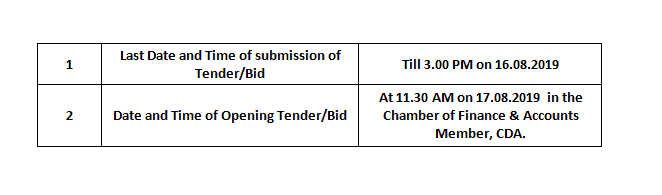
Cuttack Development Authority invites proposals from intending Chartered Accountant Firms for “Appointment of Internal Auditor, Tax Auditor and Income Tax Retainer of CDA for the Financial Year 2018-19 (Assessment Year 2019-20)”. The last date of submission of Bid is 16.08.2019 upto 3.00 PM. The details TENDER/BID DOCUMENTS can be obtained fom CDA’s website: (PORTAL) www.cdacuttack.nic.in.

An Internal Auditor cannot be the Tax Auditor of the same Organisation as stipulated by ICAI, New Delhi. 

SCOPE OF AUDIT
Compilation of Accounts :

1. The Internal Auditor has to compile the Accounts of Cuttack Development Authority for the Financial Year 2018-19.

2. Prepare necessary Annual Financial Statement i.e. Trial Balance, Income Statement, Balance Sheet and other Schedules and Annexure to be part of the Internal Audit Report, Including Bank Reconciliation Statement.

3. The Chartered Accountants has to prepare the Annual Financial Statements of Cuttack Development Authority, Cuttack after due compliance of Accounting Standards prescribed by ICAI.

4. Notes on accounts are mandatory and part of the Annual Financial Statements.

5. The Chartered Accountants needs to suggest and reflect the best ways of reporting Annual Statements of Accounts as per the best Corporate practice and conventions.

6. The Annual Statements of Accounts to be duly signed by the Chartered Accountants.

Internal Audit :

1. The responsibilities of the internal auditors shall include reporting on the adequacy of internal controls, the accuracy and propriety of transactions, the extent to which assets are accounted for and safeguarded, and the level of compliance with financial norms and procedures adopted in CDA.

2. Submission of reports on the revenue leakage and recommendation to prevent such leakages and other constructive measure for efficient maintenance of Books of Accounts.

3. Deliveries : Internal Audit Report duly signed by Chartered Accountants with Income Statement, Balance Sheet, Schedules and Annexure.

4. Industries best practice and reporting to be reflected in the Internal Audit Report of CDA.

Management Consultant :

1. Advise the Authority on the capacity as a Management Consultant.

2. Consultant in the matter relating to Service Tax under relevant Finance Act.

3. Consultant in filling E-TDS Quarterly Returns for Salary and Non Salary TDS.

Filling Income Tax Return :

The Chartered Accountant will file Income Tax Returns of Cuttack Development Authority by 30th September 2019 positively.

Criteria for Selection of Chartered Accountants :

1. The firm should have the head quarter in State of Odisha having its office/branches in Cuttack/Bhubaneswar.

2. The firm must have been empanelled with Comptroller and Auditor General of India.

3. The firm must not have been debarred from ICAI or RBI or any other statutory autonomous body for any misconduct.

4. The firms should have at least 3 FCA’s (details to be mentioned in Form T-3).

5. The firm should be auditors or should have carried out internal audit for at least 2 State Govt./ Semi Govt/PSU/ Development Authority. (details to be mentioned in Form T-4).

6. The firm must be at least 10 years old.

7. The average turnover of the CA Firm must be above Rs. 30.00 lakh (average of FY 2015-16, 2016-17 & 2017-18).

8. The firm must undertake to deploy at least 1 FCA and 2 staff of the aforesaid assignments.

9. The Authority reserves the right to cancel/reject any or all tender without assigning any reason thereof.

Selection of Chartered Accountants :-

Interested firms shall submit their bids directly to the Finance & Accounts
Member, CDA in two parts- Technical bids (T-1, T-2, T-3, T-4, T-5) and Financial bids (F-1), both the bids should be submitted in two separate envelopes marked Technical Bid and Financial Bid and properly sealed.

Financial bids of only technically qualified firms shall be opened by the
Finance & Accounts Member and audit to be awarded to the lowest financial bidder.

If the lowest financial bidder does not agree to undertake the audit work
within the prescribed audit fee or the Finance and Accounts Member deems it unfit for any reason (reasons to be recorded in writing), the job may be awarded to the next lowest financial bidder if the firm agrees to undertake the job. However, the work may only be awarded to a technically qualified bidder.

Termination / Cancellation of Appointment :

If the selected firm has not sent the Technical Bid/ Financial Bid duly signed by them within the stipulated time, their bid is liable to be rejected.

If any of the information/ documents furnished by the auditor is found to be
incorrect, the offer will automatically stand cancelled without entertaining any further correspondence.

The appointment is for the Financial Year 2018-19 and the same may be renewed on a yearly basis subject to satisfactory performance. The maximum period of contract shall be restricted to 2 Financial Years. However, the Cuttack Development Authority reserves the right to terminate the contract at any point of time for whatsoever reasons.

Manner of Submission of Bids :

1. The Bids to be submitted in two separate covers superscribing “Technical Bids for Appointment of Chartered Accountants Firm as Internal Auditor of Cuttack Development Authority, Cuttack for the Financial Year 2018-19.

2. And “Financial Bid for Appointment of Chartered Accountants Firm as Internal Auditor of Cuttack Development Authority, Cuttack for the Financial Year 2018-19.

3. The Information submitted must be written in English, Overwriting and Correction should be avoided.

4. The Bids should reach the Finance & Accounts Member, Cuttack Development Authority, Arunodaya Bhawan, Link Road, Cuttack-753012 latest by 16th August 2019 upto 3.00 PM, through Speed Post /Registered Post only. The same will be opened on 17th August 2019 at 11.30 AM in the Chamber of Finance & Accounts Member, CDA. 

5. Any information about the detail scope of work, nature of accounts and procedure followed in CDA, the Chartered Accountants Firms may contact the Deputy Finance Manager, CDA Cell No: 9938014452 on any working days.

Click Below Link To Download The Full Pdf

Download(0)

The post E-Tender For Chartered Accountant Firm as Internal Auditor of Cuttack Development Authority appeared first on Studycafe.


from Studycafe https://ift.tt/2YBudfi

Thursday, August 1, 2019

GST Revenue collection for the month of July, 2019 stands at ₹ 1,02,083 cr.

GST Revenue collection for the month of July, 2019 stands at ₹ 1,02,083 cr.

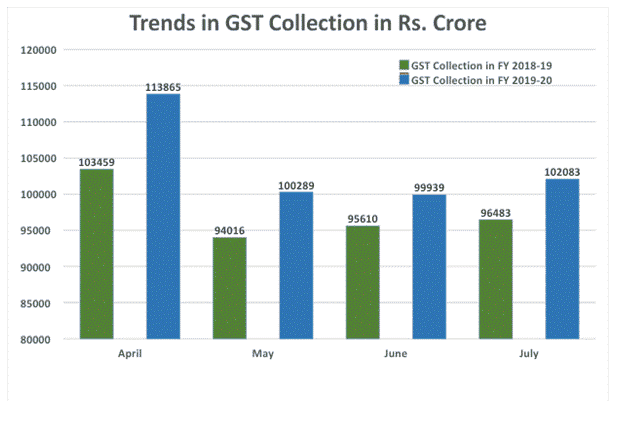
The total gross GST revenue collected in the month of July, 2019 is ₹ 1,02,083 crore of which CGST is ₹ 17,912 crore, SGST is ₹ 25,008 crore, IGST is ₹ 50,612 crore (including ₹ 24,246 crorecollected on imports) and Cess is ₹ 8,551 crore (including ₹797 crore collected on imports). The total number of GSTR 3B Returns filed for the month of June up to 31st July, 2019 is 75.79 lakh.

The revenue in July, 2018 was ₹ 96,483 crore and the revenue during July, 2019 is a growth of 5.80% over the revenue in the same month last year. During April-July 2019 vis-à-vis 2018, the domestic component has grown by 9.2% while the GST on imports has come down by 0.2% and the total collection has grown by 6.83%. Rs. 17,789 crore has been released to the states as GST compensation for the months of April-May, 2019.

The chart shows trends in revenue during the current year.

The post GST Revenue collection for the month of July, 2019 stands at ₹ 1,02,083 cr. appeared first on Studycafe.


from Studycafe https://ift.tt/2YzjP7z

Lite E-Filing & modified IT software issued by CBDT; software available for download

Lite E-Filing & modified IT software issued by CBDT; software available for download

Income tax department is launching ‘e-Filing Lite’, a lighter version of e-Filing portal with a focus on filing of Income Tax Return (ITR) by the taxpayers. The same can be accessed by clicking ‘e-Filing Lite’ button in home page. The current e-Filing portal having all the services can be accessed by clicking on ‘Portal Login’ button. 

CBDT has extended the due date for filing Income Tax Returns for certain category of assesses from July 31, 2019 to August 31, 2019. Accordingly the IT return preparation software are modified to update the 234A interest calculation along with certain other minor corrections and the same is available for download. 

The post Lite E-Filing & modified IT software issued by CBDT; software available for download appeared first on Studycafe.


from Studycafe https://ift.tt/2LT3WDh

CBIC exempt the hiring of Electric buses by local authorities from GST

CBIC exempt the hiring of Electric buses by local authorities from GST

Government of India
Ministry of Finance
(Department of Revenue)

Notification No.13/2019- Central Tax (Rate)

New Delhi, the 31st July 2019

G.S.R……(E).- In exercise of the powers conferred by sub-section (1) of section 11 of the Central Goods and Services Tax Act, 2017 (12 of 2017), the Central Government, on being satisfied that it is necessary in the public interest so to do, on the recommendations of the Council, hereby makes the following further amendments in the notification of the Government of India, in the Ministry of Finance (Department of Revenue), No.12/2017- Central Tax (Rate), dated the 28thJune, 2017, published in the Gazette of India, Extraordinary, Part II, Section 3, Sub-section (i), vide number G.S.R. 691(E), dated the 28th June, 2017, namely :-

In the said notification, in the Table, against serial number 22, in the entries in column (3), after clause (a), the following clause shall be inserted, namely: –

(3)
‘(aa) to a local authority, an Electrically operated vehicle meant to carry more than twelve passengers; or

Explanation.- For the purposes of this entry, “Electrically operated vehicle” means vehicle falling under Chapter 87 in the First Schedule to the Customs Tariff Act, 1975 (51 of 1975) which is run solely on electrical energy derived from an external source or from one or more electrical batteries fitted to such road vehicle.’

2. This notification shall come into force with effect from the 1st of August, 2019.

[F. No.354/47/2018 -TRU]

(Gunjan Kumar Verma)
Under Secretary to the Government of India

Note : -The principal notification was published in the Gazette of India, Extraordinary, vide notification No. 12/2017 – Central Tax (Rate), dated the 28thJune, 2017, vide number G.S.R. 691 (E), dated the 28thJune, 2017 and was last amended by notification No. 4/2019 – Central Tax (Rate),dated the 29th March 2019 vide number G.S.R. 251(E), dated the 29th March 2019.

The post CBIC exempt the hiring of Electric buses by local authorities from GST appeared first on Studycafe.


from Studycafe https://ift.tt/315GIgH

Last date for filing of intimation in FORM GST CMP-02 extended to 30.9.2019

Last date for filing of intimation in FORM GST CMP-02 extended to 30.9.2019

Government of India
Ministry of Finance
Department of Revenue
Central Board of Indirect Taxes and Customs
GST Policy Wing

New Delhi, Dated the 29th July, 2019

To,

The Principal Chief Commissioners/ Chief Commissioners/ Principal Commissioners/ Commissioners of Central Tax (All)

The Principal Director Generals/ Director Generals (All)

Madam/Sir,

Subject : Corrigendum to Circular No. 97/16/2019-GST dated 5th April, 2019 issued vide F. No. CBEC/20/16/4/2018-GST (Pt. I), as amended vide Corrigendum dated 01.07.2019 – reg.

In para 2(i) of the Circular No. 97/16/2019-GST dated 5th April, 2019, as amended vide Corrigendum dated 01.07.2019,

for

“(i) a registered person who wants to opt for payment of central tax @ 3% by availing the benefit of the said notification, may do so by filing intimation in the manner specified in sub-rule 3 of rule 3 of the said rules in FORM GST CMP-02 by selecting the category of registered person as “Any other supplier eligible for composition levy” as listed at Sl. No. 5(iii) of the said form, latest by 31st July, 2019. Such person shall also furnish a statement in FORM GST ITC-03 in accordance with the provisions of sub-rule (3) of rule 3 of the said rules.”

“(i) a registered person who wants to opt for payment of central tax @ 3% by availing the benefit of the said notification, may do so by filing intimation in the manner specified in sub-rule 3 of rule 3 of the said rules in FORM GST CMP-02 by selecting the category of registered person as “Any other supplier eligible for composition levy” as listed at Sl. No. 5(iii) of the said form, latest by 30th September, 2019. Such person shall also furnish a statement in FORM GST ITC-03 in accordance with the provisions of sub-rule (3) of rule 3 of the said rules.”

2. It is requested that suitable trade notices may be issued to publicize the contents of this Circular.

3. Difficulty, if any, in implementation of this Circular may please be brought to the notice of the Board. Hindi version would follow.

(Upender Gupta)
Pr. Commissioner (GST)

The post Last date for filing of intimation in FORM GST CMP-02 extended to 30.9.2019 appeared first on Studycafe.


from Studycafe https://ift.tt/2M17fIH