Monday, March 30, 2020

No Extension of Financial Year, Clarifies MOF

No Extension of Financial Year, Clarifies MOF

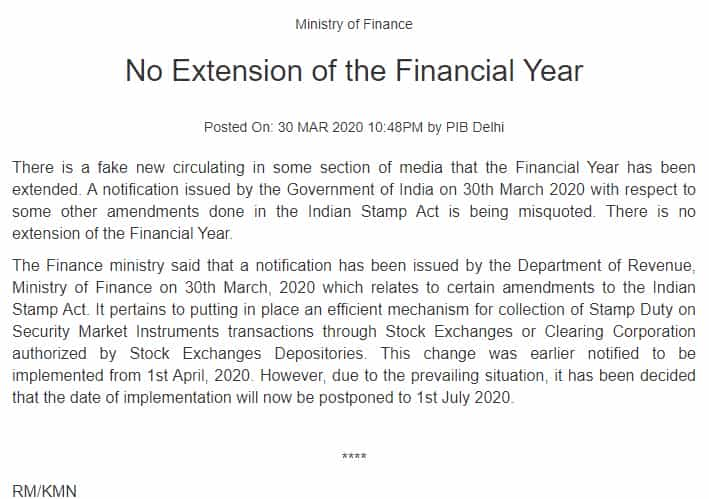
There is a fake new circulating in some section of media that the Financial Year has been extended. A notification issued by the Government of India on 30th March 2020 with respect to some other amendments done in the Indian Stamp Act is being misquoted. There is no extension of the Financial Year.

The Finance ministry said that a notification has been issued by the Department of Revenue, Ministry of Finance on 30th March, 2020 which relates to certain amendments to the Indian Stamp Act. It pertains to putting in place an efficient mechanism for collection of Stamp Duty on Security Market Instruments transactions through Stock Exchanges or Clearing Corporation authorized by Stock Exchanges Depositories. This change was earlier notified to be implemented from 1st April, 2020. However, due to the prevailing situation, it has been decided that the date of implementation will now be postponed to 1st July 2020.

No Extension of Financial Year, Clarifies MOF

The post No Extension of Financial Year, Clarifies MOF appeared first on Studycafe.


from Studycafe https://ift.tt/3bCWQvd

Apportionment of input tax credit in case of business reorganization: FAQ’s

Apportionment of input tax credit in case of business reorganization: FAQ’s

Q. In case of demerger, proviso to rule 41 (1) of the CGST Rules provides that the input tax credit shall be apportioned in the ratio of the value of assets of the new units as specified in the demerger scheme. However, it is not clear as to whether the value of assets of the new units is to be considered at State level or at all-India level?

The explanation to rule 41(1) of the CGST Rules states that “value of assets” means the value of the entire assets of the business, whether or not input tax credit has been availed thereon. The value of assets of the new units is to be taken at the State level (at the level of distinct person) and not at the all-India level.

Q. Is the transferor required to file FORM GST ITC – 02 in all States where it is registered?

No. The transferor is required to file FORM GST ITC – 02 only in those States where both transferor and transferee are registered.

Q. The proviso to rule 41 (1) of the CGST Rules explicitly mentions ‘demerger’. Other forms of business reorganization where part of business is hived off or business in transferred as a going concern etc. have not been covered in the said rule. Wherever business reorganization results in partial transfer of business assets along with liabilities, whether the proviso to rule 41(1) of the CGST Rules, 2017 shall be applicable to calculate the amount of transferable ITC?

Yes, the formula for apportionment of ITC, as prescribed under proviso to rule 41(1) of the CGST Rules, shall be applicable for all forms of business re-organization that results in partial transfer of business assets along with liabilities.

Q. Whether the ratio of value of assets, as prescribed under proviso to rule 41 (1) of the CGST Rules, shall be applied in respect of each of the heads of input tax credit viz. CGST/SGST/ IGST/ Cess?

No, the ratio of value of assets, as prescribed under proviso to sub-rule (1) of rule 41 of the CGST Rules, shall be applied to the total amount of unutilized input tax credit (ITC) of the transferor i.e. sum of CGST, SGST/UTGST and IGST credit. The said formula need not be applied separately in respect of each heads of ITC (CGST/SGST/IGST). Further, the said formula shall also be applicable for apportionment of Cess between the transferor and transferee.

Q. How to determine the amount of ITC that is to be transferred to the transferee under each tax head (IGST/CGST/SGST) while filing of FORM GST ITC–02 by the transferor?

The transferor shall be at liberty to determine the amount to be transferred under each tax head (IGST, CGST, SGST/UTGST) within this total amount, subject to the ITC balance available with the transferor under the concerned tax head.

Q. In order to calculate the amount of transferable ITC, the apportionment formula under proviso to rule 41(1) of the CGST Rules has to be applied to the unutilized ITC balance of the transferor. However, it is not clear as to which date shall be relevant to calculate the amount of unutilized ITC balance of transferor?

The apportionment formula shall be applied on the ITC balance of the transferor as available in electronic credit ledger on the date of filing of FORM GST ITC – 02 by the transferor.

Q. Which date shall be relevant to calculate the ratio of value of assets, as prescribed in the proviso to rule 41 (1) of the CGST Rules, 2017?

The “appointed date of demerger” is the date from which the scheme for demerger comes into force and it is specified in the respective scheme of demerger. Therefore, for the purpose of apportionment of ITC under rule 41(1) of the CGST Rules, the ratio of the value of assets should be taken as on the “appointed date of demerger”.

For the purpose of apportionment of ITC under rule 41(1) of the CGST Rules, while the ratio of the value of assets should be taken as on the “appointed date of demerger”, the said ratio is to be applied on the ITC balance of the transferor on the date of filing FORM GST ITC – 02 to calculate the amount to transferable ITC.

Referance :

The post Apportionment of input tax credit in case of business reorganization: FAQ’s appeared first on Studycafe.


from Studycafe https://ift.tt/2UODCMq

New Procedure For GST Compliance For IRP/RP

New Procedure For GST Compliance For IRP/RP, corporate debtors who are undergoing the CIRP

CBIC Notification No. 11/2020–Central Tax dated 21.03.2020 prescribes, New Procedure For GST Compliance For IRP/RP,  corporate debtors under the provisions of the Insolvency and Bankruptcy Code, 2016 who are undergoing the corporate insolvency resolution process (CIRP) and the management of whose affairs are being undertaken by interim resolution professionals (IRP) or resolution professionals (RP) from the date of the appointment of the IRP/RP till the period they undergo the corporate insolvency resolution process (CIRP)

IRP /RP be treated as a distinct person of the corporate debtor, and shall be liable to take a new registration –

The said class of persons shall, with effect from the date of appointment of IRP /RP, be treated as a distinct person of the corporate debtor, and shall be liable to take a new registration in each of the States or Union territories where the corporate debtor was registered earlier, within thirty days of the appointment of the IRP/RP.

Provided that in cases where the IRP/RP has been appointed prior to the date of this notification, he shall take registration within thirty days from the commencement of this notification, with effect from date of his appointment as IRP/RP.

Returns to be filed – The said class of persons shall, after obtaining registration file the first return under section 40 of the said Act, from the date on which he becomes liable to registration till the date on which registration has been granted.

New Procedure For GST Compliance For IRP/RP

Input tax credit – The said class of persons shall, in his first return, be eligible to avail ITC on invoices covering the supplies of goods or services or both, received since his appointment as IRP/RP but bearing the GSTIN of the erstwhile registered person, subject to the conditions of Chapter V of the CGST Act and the rules made thereunder, except the provisions of section 16(4) of the CGST Act and rule 36(4) of the CGST Rules, 2017.

Registered persons who are receiving supplies from the said class of persons shall, for the period from the date of appointment of IRP / RP till the date of registration as required in this notification or thirty days from the date of this notification, whichever is earlier, be eligible to avail input tax credit on invoices issued using the GSTIN of the erstwhile registered person, subject to the conditions of Chapter V of the CGST Act and the rules made thereunder, except the provisions of rule 36(4) of the CGST rules.

Refund of Tax Deposited: Any amount deposited in the cash ledger by the IRP/RP, in the existing registration, from the date of appointment of IRP/RP to the date of registration in terms of this notification shall be available for refund to the erstwhile registration.

How are dues under GST for pre-CIRP period be dealt?

In accordance with the provisions of the IBC and various legal pronouncements on the issue, no coercive action can be taken against the corporate debtor with respect to the dues for period prior to insolvency commencement date.

The dues of the period prior to the commencement of CIRP will be treated as ‘operational debt’ and claims may be filed by the proper officer before the NCLT in accordance with the provisions of the IBC. The tax officers shall seek the details of supplies made / received and total tax dues pending from the corporate debtor to file the claim before the NCLT. Moreover, section 14 of the IBC mandates the imposition of a moratorium period, wherein the institution of suits or continuation of pending suits or proceedings against the corporate debtor is prohibited.

Should the GST registration of corporate debtor be cancelled?

It is clarified that the GST registration of an entity for which CIRP has been initiated should not be cancelled under the provisions of section 29 of the CGST Act, 2017. The proper officer may, if need be, suspend the registration. In case the registration of an entity undergoing CIRP has already been cancelled and it is within the period of revocation of cancellation of registration, it is advised that such cancellation may be revoked by taking appropriate steps in this regard.

Is IRP/RP liable to file returns of pre-CIRP period?

No. In accordance with the provisions of IBC, 2016, the IRP/RP is under obligation to comply with all legal requirements for period after the Insolvency Commencement Date. Accordingly, it is clarified that IRP/RP are not under an obligation to file returns of pre-CIRP period.

Some of the IRP/RPs have made deposit in the cash ledger of erstwhile registration of the corporate debtor. How to claim refund for amount deposited in the cash ledger by the IRP/RP?

Any amount deposited in the cash ledger by the IRP/RP, in the existing registration, from the date of appointment of IRP / RP to the date of notification specifying the special procedure for corporate debtors undergoing CIRP, shall be available for refund to the erstwhile registration under the head refund of cash ledger, even though the relevant FORM GSTR-3B/GSTR-1 are not filed for the said period.

The post New Procedure For GST Compliance For IRP/RP appeared first on Studycafe.


from Studycafe https://ift.tt/2Ut3FtL

EMPLOYEES’ PROVIDENT FUNDS (AMENDMENT) SCHEME, 2020

EMPLOYEES’ PROVIDENT FUNDS (AMENDMENT) SCHEME, 2020

MINISTRY OF LABOUR AND EMPLOYMENT vide Gazette ID CG-DL-E-28032020-218950 dated 28.03.2020 has issued Employees’ Provident Funds (Amendment) Scheme, 2020 in exercise of the powers conferred by section 5 read with sub-section (1) of section 7 of the Employees’ Provident Funds and Miscellaneous Provisions Act, 1952

Applicability: with immediate effect from 30.03.2020

In the Employees’ Provident Funds Scheme, 1952, in paragraph 68L, after sub-paragraph (2), the following sub-paragraph shall be inserted, namely:-–

―(3) The Commissioner or, where so authorized by the Commissioner, any officer subordinate to him, may, on an application from any member of this Scheme employed in any establishment or factory located in an area declared as affected by outbreak of any epidemic or pandemic by the appropriate Government, permit a non-refundable advance from the provident fund account of such member not exceeding the basic wages and dearness allowances of that member for three months or up to seventy-five per cent. of the amount standing to his credit in the Fund, whichever is less.

Link

The post EMPLOYEES’ PROVIDENT FUNDS (AMENDMENT) SCHEME, 2020 appeared first on Studycafe.


from Studycafe https://ift.tt/39r4vLS

PRESS RELEASE BY RESERVE BANK OF INDIA ON STATEMENT ON DEVELOPMENT AND REGULATORY POLICIES

RBI on 27.03.2020 issued a press release on STATEMENT ON DEVELOPMENT AND REGULATORY POLICIES which states the following policy announcement.

  1. LIQUIDITY MANAGEMENT.
  2. Targeted Long-Term Repos Operations (TLTROs).
  3. Cash Reserve Ratio.
  4. Marginal Standing Facility.
  5. Widening of the Monetary Policy Rate Corridor.
  6. Moratorium on Term Loans.
  7. Deferment of Interest on Working Capital Facilities.
  8. Easing of Working Capital Financing.
  9. Deferment of Implementation of Net Stable Funding Ratio (NSFR).
  10. Deferment of Last Tranche of Capital Conservation Buffer
  11. Permitting Banks to Deal in Offshore Non-Deliverable Rupee Derivative Markets (Offshore NDF Rupee Market)
  12. REGULATION AND SUPERVISION.

“Alongside liquidity measures, it is important that efforts are undertaken to mitigate the burden of debt servicing brought about by disruptions on account of the fall-out of the COVID-19 pandemic. Such efforts, in turn, will prevent the transmission of financial stress to the real economy, and will ensure the continuity of viable businesses and provide relief to borrowers in these extraordinarily troubled times”.

  • FINANCIAL MARKETS.

“The decision in respect of financial markets is essentially of a developmental nature, intended to improve depth and price discovery in the forex market segments by reducing arbitrage between onshore and offshore markets. This measure assumes greater importance in the context of the increased volatility of the rupee caused by the impact of COVID-19 on currency markets”.

While the measures taken by RBI are in the right direction pumping in more liquidity for the banks to lend and to take care of the emerging emergency anticipated liquidity crisis to some extent, the lowering of repo rates may lead to lowering of the lending rates by the bank which may reciprocate in reducing the deposit rates also which is a natural corollary of the market behaviour. Under the existing market conditions and the financial volatility, no body can predict the future market behaviour and financial situation and liquidity. It may take two to three years for the market to stabilise for growth of business and the liquidity crisis to ease leading to better and sufficient cash flow to meet the financial commitments. In this connection let us not forget what happened after the collapse of Lehman Bros in U S in the year 2008 and its effect on the global economy. What is happening now is the worst calamity and tragedy unprecedented so far affecting the global economy.

Taking into account the uncertainty prevailing with regard to the spread of the deadly decease of corona virus and its longevity, how the liquidity and more so the burden of servicing of debt and interest are going to be ensured in the absence of any signs of abetting of this ranging pandemic catastrophe. The repayment of debt and servicing of term loan depend on the cash flow. Hence, mere moratorium on the repayment of debt / or EMI for three months will not give any relief to the borrowers unless the adequate cash flow is ensured. Same with deferment of interest on working capital. The only way to give relief will be to reassess and re-appraise the cash flow and fix the repayment of installments and servicing of interest with adequate moratorium and extended tenure to repay the loan and servicing of interest based on the revised cash flow. The revised repayment terms will not be uniform for all the loans and it will vary from account to account depending on the revised cash flow. Even staggering of margin money requirement also may be considered.

It can be observed that RBI Governor’s statement shows that RBI has announced its policy but the methodology of implementation is left to the banks which have given the loans to formulate their policy at their discretion. Instead if RBI had announced the methodology of implementing the regulatory policy in a uniform way and mandatory for all the banks to implement it, it would have ensured equality of reliefs without any distinction and discrimination. Besides, it would have also given the benefit of reduction in interest uniformly to all the borrowers. However, it is to be seen how the banks are going to implement the RBI development and regulatory policies for the benefit of the customers.      

T. R. Radhakrishnan

(The Author invites comments from readers and he can be contacted through his e-mail trrk1941@gmail.com)

The post PRESS RELEASE BY RESERVE BANK OF INDIA ON STATEMENT ON DEVELOPMENT AND REGULATORY POLICIES appeared first on Studycafe.


from Studycafe https://ift.tt/2WXHMEr

Sunday, March 29, 2020

PM Narendra Modi Appeal to Contribute in PM CARES fund to fight Coronavirus

PM Narendra Modi Appeal to Contribute in PM CARES fund to fight Coronavirus

Prime Minister Narendra Modi has announced the constitution of the PM’s Citizen Assistance and Relief in Emergency Situations (PM-CARES) fund. This will be a dedicated national fund with the primary objective of dealing with any kind of emergency or distress situation, like posed by the COVID-19 pandemic.

The emergency fund was created by Prime Minister Narendra Modi on Saturday after his office received numerous requests from people for donations to support the government in its fight against the impact of Covid-19.

Prime Minister is the Chairman of this trust and its Members include Defence Minister, Home Minister and Finance Minister. Citizens and organisations can go to the website pmindia.gov.in and donate to PM CARES Fund.

This fund will enable micro-donations allowing a large number of people will be able to contribute with smallest of denominations. Donations to this fund will be exempted from income tax under section 80(G). Mr Modi has always believed and shown in actions that public participation is the most effective way to mitigate any issue and this is yet another example.


In a series of tweets, Prime Minister said, people from all walks of life have expressed their desire to donate to India’s war against COVID-19. He appealed to the people to contribute to the PM-CARES Fund. Prime Minister said, this will go a long way in creating a healthier India. He said, this fund will also cater to similar distressing situations, if they occur in the times ahead.

Mr Modi has said that every single contribution in the PM- CARES Fund matters and there is nothing big or little. Reacting to the enthusiastic response of the people, he said that it shows our collective resolve to defeat COVID-19. In response to a student’s contribution, Mr Modi said, the future of the nation is ensuring the nation’s future.

Citizens and organisations can go to the website pmindia.gov.in and donate to PM CARES Fund using following details:

Name of the Account : PM CARES

Account Number : 2121PM20202

IFSC Code          : SBIN0000691

SWIFT Code        : SBININBB104

Name of Bank & Branch : State Bank of India, New Delhi Main Branch

UPI ID : pmcares@sbi

Following modes of payments are available on the website pmindia.gov.in –

  • Debit Cards and Credit Cards
  • Internet Banking
  • UPI (BHIM, PhonePe, Amazon Pay, Google Pay, PayTM, Mobikwik, etc.)
  • RTGS/NEFT

Donations to this fund will be exempted from income tax under section 80(G).

The post PM Narendra Modi Appeal to Contribute in PM CARES fund to fight Coronavirus appeared first on Studycafe.


from Studycafe https://ift.tt/2wIPdEI

Friday, March 27, 2020

Finance Act 2020 notified by Finance Ministry

Finance Act 2020 notified by Finance Ministry

Amidst the COVID-19 outbreak and lockdown in various states, the Finance Bill 2020 introduced vide Union Budget 2020-21 was passed by both Houses of Parliament, with certain amendments including relaxation of ‘deemed residency’ rule for Indian citizens not liable to tax in any other country, enlargement in the scope of Equalization levy to include e-commerce supply or services, etc. Finance Act 2020 has been notified by Finance Ministry. Here are the key amendments of this Act:

1. Tax Rates:

A. TAX RATES APPLICABLE TO INDIVIDUAL AND HINDU UNDIVIDED FAMILY (HUF)

a) Option – I (OLD SCHEME)

Income (Rs.) Proposed rate of tax (AY 2021-22)
Upto 2,50,000* Nil
2,50,001-5,00,000 5%
5,00,001-10,00,000 20%
10,00,001 and above 30%

* For Senior Citizen Exemption Limit is Rs.3,00,000 and for Super Senior Citizen (80 years and above) Exemption Limit is Rs. 5,00,000

b) Option – II (NEW SCHEME)

Income (Rs.) Proposed rate of tax (AY 2021-22)
Up to Rs 2.5 lakh Nil
From 2,50,001 to Rs 5 lakh 5 per cent.
From 5,00,001 to Rs 7.5 lakh 10 per cent.
From 7,50,001 to Rs 10 lakh 15 per cent.
From 10,00,001 to Rs 12.5 lakh 20 per cent.
From 12,50,001 to Rs 15 lakh 25 per cent.
Above Rs 15 lakh 30 per cent.

*NOTE –

i. Refer Para 2 for other terms & conditions of new scheme.

ii. Cess @ 4% is leviable on the amount of income tax and surcharge, if any.

iii. Rebate under Section 87A continues for a resident individual whose total income does not exceed 5,00,000. The amount of rebate is 100% of income tax calculated before cess or 12,500 whichever is less (There is no mention of amendment of Section 87 A in Finance Bill; Accordingly it appears that deduction under the said section will still be available).

c) Surcharge to be added 

Income (Rs.) (AY 2021-22)
Upto 50 Lakhs  Nil
50 Lakhs –  1 Crore 10%
1 Crore –  2 Crores 15%
2 Crore –  5 Crores 25%
Above 5 Crores 37%

B. CORPORATE TAX RATES

Turnover Particulars Tax Rate
Gross turnover upto 400 Cr. in the FY 2017-18 25%
Gross turnover exceeding 400 Cr. in the FY 2017-18 30%
Where the company opted for Section 115BA 25%
Where the company opted for Section 115BAA 22%
Where the company opted for Section 115BAB 15%

In addition cess and surcharge is levied as follows:

Cess: 4% of corporate tax

Surcharge applicable:

Income Limit Surcharge Rate on the amount of income tax
Net income exceeds Rs.1 Crore but doesn’t exceed Rs.10 Crore 7%
Net income exceeds Rs.10 Crore 12%

However, the rate of surcharge in case of a company opting for taxability under Section 115BAA or Section 115BAB shall be 10% irrespective of amount of total income.

C. FIRMS

Flat tax rate of 30% and surcharge @ 12% of income tax if income exceeds Rs. 1 Cr. ; Further cess @4% will be levied.

2. Exemptions removed under new tax regime

Individual or HUF opting for taxation under the newly inserted section 115BAC of the Act shall not be entitled to the following exemptions / deductions :

(i) Leave travel concession as contained in clause (5) of section 10;

(ii) House rent allowance as contained in clause (13A) of section 10;

(iii) Some of the allowance as contained in clause (14) of section 10;

(iv) Allowances to MPs/MLAs as contained in clause (17) of section 10;

(v) Allowance for income of minor as contained in clause (32) of section 10;

(vi) Exemption for SEZ unit contained in section 10AA;

(vii) Standard deduction, deduction for entertainment allowance and employment / professional tax as contained in section 16;

(viii) Interest under section 24 in respect of self-occupied or vacant property referred to in sub-section (2) of section 23. (Loss under the head income from house property for rented house shall not be allowed to be set off under any other head and would be allowed to be carried forward as per extant law);

List of Exemptions/Deductions available under new tax regime – Budget 2020

(ix) Additional deprecation under clause (iia) of sub-section (1) of section 32;

(x) Deductions under section 32AD, 33AB, 33ABA;

(xi) Various deduction for donation for or expenditure on scientific research contained in sub-clause (ii) or sub-clause (iia) or sub-clause (iii) of sub-section (1) or sub-section (2AA) of section 35;

(xii) Deduction under section 35AD or section 35CCC;

(xiii) Deduction from family pension under clause (iia) of section 57;

(xiv) Any deduction under chapter VIA (like section 80C, 80CCC, 80CCD, 80D, 80DD, 80DDB, 80E, 80EE, 80EEA, 80EEB, 80G, 80GG, 80GGA, 80GGC, 80IA, 80-IAB, 80-IAC, 80-IB, 80-IBA, etc). However, deduction under sub-section (2) of section 80CCD (employer contribution on account of employee in notified pension scheme) and section 80JJAA (for new employment) can be claimed.

Following allowances shall be allowed as notified under section 10(14) of the Act to the Individual or HUF exercising option under the proposed section :

a) Transport Allowance granted to a divyang employee to meet expenditure for the purpose of commuting between place of residence and place of duty

b) Conveyance Allowance granted to meet the expenditure on conveyance in performance of duties of an office;

c) Any Allowance granted to meet the cost of travel on tour or on transfer;

d) Daily Allowance to meet the ordinary daily charges incurred by an employee on account of absence from his normal place of duty.

3. Finance Act 2020 abolished Dividend Distribution Tax (DDT) on dividends. Instead, it made dividends taxable in the hands of investors at their slab rate.

4. Tax Audit Threshold increased.

In wake of ease of doing business, Tax Audit threshold has been increased to 5 crores from existing 1 crore by Finance Act 2020.

5. Changes in provision determining Residential Status of any individual

Click here to Download

The post Finance Act 2020 notified by Finance Ministry appeared first on Studycafe.


from Studycafe https://ift.tt/2QQxVwg