Thursday, February 25, 2021

DGFT issues Electronic filing and Issuance of Preferential Certificate of Origin (CoO) for India’s Exports

DGFT issues Electronic filing and Issuance of Preferential Certificate of Origin (CoO) for India’s Exports

Government of India
Ministry of Commerce and Industry
Department of Commerce
Directorate General of Foreign Trade

Dated: 23.02.2021

Trade Notice No. 43/2020-2021

Udyog Bhawan, New Delhi

To,

All Exporters/Members of Trade

All Designated Issuing Agencies under FTAs/PTAs

Subject: Electronic filing and Issuance of Preferential Certificate of Origin (CoO) for India’s Exports under India-Mercosur PTA and India-Thailand EHS w.e.f. 25th February 2021

In continuation to the earlier Trade Notice(s) 34/2015-2020 dated 19.09.2019, 41/2019-2020 dated 12.12.2020, 53/2019-2020 dated 02.03.2020, 01/2020-2021 dated 07.04.2020 and 30/2020-2021 dated 13.10.2020, it is informed that the electronic platform for Preferential Certificate of Origin(CoO) is being expanded further to add two (2) more FTAs/PTAs to facilitate electronic application of Preferential Certificates of Origin under the given Trade Agreements.

2. The Preferential Certificate of Origin for exports to countries under the following trade agreements i.e.

i. India-Mercosur Preferential Trade Agreement
ii. India-Thailand Early Harvest Scheme

shall also be applied and issued from the CoO e-platform with effect from 25th February 2021. No manual application for such a CoO should be submitted to an issuing agency from 25th February 2021. Any manual applications submitted prior to the given date may however be processed by the issuing agencies.

3. It is informed that for these applications under the above mentioned Trade Agreements, the e-CoO system shall generate all the existing set of CoO copies besides an additional copy i.e. electronic copy. The electronic copy shall bear the image signature of the officer and stamp of the issuing agency. The exporter may however get the remaining copies duly ink-signed by the issuing officer along with the stamp of the issuing office. The paper copies of the CoOs so issued may be collected by post or in person, for any submission to the Trade Agreement’s partner countries authorities.

4. The concerned Indian Exporters may please take note of the following points with regard to the process being notified herewith:

  • Digital Signature Certificate (DSC) would be required for the purpose of electronic submission. The digital signature would be the same as used in other DGFT applications;
  • The digital signature may be Class II or Class III and should have the IEC of the firm embedded in the DSC;
  • Any new applicant exporter would be required to initially register at the portal. The password would be sent on the email and mobile number of the IEC holder. In case the IEC holder desires to update their email on which communication is to be sent, the same may be done by using the ‘IEC Profile Management’ service on the DGFT website https://dgft.gov.in
  • Once registration is completed, the IEC branch details would be auto-populated as per the DGFT-IEC database. Applicant is required to ensure that updated IEC details are available in the DGFT system. Necessary steps may be taken to modify the IEC details online, whenever required.

5. For further guidance on registration and application submission, the Help manual & FAQs may be accessed on the landing page at https://coo.dgft.gov.in . For any further assistance you may utilize any of the following channels —

  • Raise a service request/suggestion ticket through the DGFT Helpdesk service
  • Call the toll-free DGFT Helpdesk numbers
  • Send an email to DGFT CoO Helpdesk at coo-dgft@gov.in

This issues with the approval of the competent authority.

(Md. Moin Afaque)
Deputy Director General of Foreign Trade

(Issued from File No. 01/02/82/AM-19/EDI)


from Studycafe https://ift.tt/2NHZObs

Power to attach bank account should be exercised strictly as it entails serious consequences

Power to attach bank account should be exercised strictly as it entails serious consequences

The Hon’ble Delhi High Court in Proex Fashion Private Limited v. Government of India & Ors. [W.P.(C) 11245/2020 & CM APPL. 35053/2020, decided on January 6, 2021] quashed the order passed for attaching the bank account of the assessee pursuant to proceedings initiated under Section 71 of the Central Goods and Services Tax Act, 2017 (“CGST Act”). Further, held that, the attachment of bank account entails serious consequences and therefore, the power to attach the bank account must be exercised only in strict compliance with the statutory provisions.

Facts:

By this present petition, Proex Fashion Private Limited (“the Petitioner”) seeks to challenge an order vide Form GST DRC-22 dated November 25, 2020 (“Impugned Order”), by which the bank account of the Petitioner had been attached by the Assistant Commissioner (“the Respondent”), purportedly under Section 83 of the CGST Act.

It is contended by the Respondent, that proceedings were initiated against the Petitioner pursuant to a communication from the Directorate General of Analytics and Risk Management (“DGARM”). The Petitioner was declared as a “risky exporter”, and an attempt was made to elicit certain information and documents from the Petitioner. However, several communications were addressed to the Petitioner at its registered office but were returned undelivered. Therefore, proceedings under Section 71 of the CGST Act were initiated against the Petitioner, and the Petitioner’s bank account was attached under Section 83 of the CGST Act pursuant to those proceedings.

Issue:

Whether the bank account of the Petitioner can be attached by the Respondent under Section 83 of the CGST Act, pursuant to proceedings initiated under Section 71 of the CGST Act?

Held:

The Hon’ble Delhi High Court in W.P.(C) 11245/2020 & CM APPL. 35053/2020, decided on January 6, 2021 held as under:

  • The Court was of the view that the Impugned Order cannot be sustained. It is clear from a plain reading of Section 83 that action thereunder is predicated upon pendency of proceedings under Sections 62, 63, 64, 67, 73 or 74 of the CGST Act.
  • Noted that, that no proceedings under any of the provisions mentioned in Section 83 of the CGST Act were in fact initiated against the Petitioner.
  • Observed that, the attachment of bank account entails serious consequences to the assessee, particularly in the case of a running concern such as the Petitioner herein. The power to attach the bank account must therefore be exercised only in strict compliance with the statutory power and cannot be extended to cover situations which are not expressly contemplated by the Section 83 of the CGST Act. Absent the statutory precondition for exercise of the power of attachment, any order under Section 83 ibid is wholly illegal and unsustainable.
  • Quashed the Impugned Order and held that, in these circumstances, the Impugned Order, is ultra vires the statutory powers of the Respondent.
  • Further stated that, this order will not preclude the Respondent from taking such action against the Petitioner as they may be entitled to in law, including passing of any orders under Section 83 of the CGST Act in accordance with the conditions of that section. However, assured that the Petitioner will supply information and documents to Respondent as and when called for.

Our Comments:

Section 83(1) of the CGST Act is proposed to be amended vide Clause No. 106 of the Finance Bill, 2021 to read as under:

“83. Provisional attachment to protect revenue in certain cases

(1) Where, after the initiation of any proceeding under Chapter XII, Chapter XIV or Chapter XV, the Commissioner is of the opinion that for the purpose of protecting the interest of the Government revenue it is necessary so to do, he may, by order in writing, attach provisionally, any property, including bank account, belonging to the taxable person or any person specified in sub-section (1A) of section 122, in such manner as may be prescribed.”

The scope of Section 83(1) of the CGST Act is proposed to be widened, so as to provide for provisional attachment of property or bank account in case of any action being initiated by authorities pertaining to assessment, inspection, search, seizure & arrest and demand & recovery, whereas, earlier, the attachment could only be made while during the pendency of any proceedings under specified Sections viz., Section 62 (assessment of non-filers of returns) or Section 63 (assessment of unregistered persons) or Section 64 (summary assessment in certain special cases) or Section 67 (power of inspection, search and seizure) or Section 73 (determination of tax in non-fraud cases) or Section 74 (determination of tax in fraud cases) of the CGST Act.

Thus, while earlier the provisions listed were more of those undertaken to check tax evasions (inspection, search, seizure, adjudication of SCN), the amended provision provides for such coercive measure even in case of regular proceedings in case of regular taxpayers like scrutiny of returns, provisional assessment, access to business premises etc. Further, such power can now be exercised even at the stage of summon.

Seemingly, such wide powers can increase the misuse of this provision by Revenue even more, when casual exercise of powers under Section 83 of the CGST Act is still under scanner of various High Courts which have time and again held in plethora of judgments that an order of provisional attachment cannot be taken as a matter of course. It is one of the drastic measures which the authority may be compelled to take if the situation demands for the purpose of protecting the interest of the Government Revenue. Recently, the Gujarat HC in Vinodkumar Murlidhar Chechani v. State of Gujarat [R/Special Civil Application No. 12498 of 2020 decided on February 3, 2021] has directed Government to issue appropriate instructions or guidelines at the earliest w.r.t to excise of power of provisional attachment under Section 83 of the CGST Act. Thus, some strict framework for exercising Section 83 needs to be put in place.

Further, the Hon’ble Bombay High Court in AJE India Private Limited v. Union of India and Ors. [Writ Petition (ST.) No. 97165 of 2020 decided on December 22, 2020] has stayed the order wherein assessee’s bank accounts were provisionally attached for recovering alleged tax dues, and held that, merely because there is a proceeding under Section 67 of the CGST Act, it would not mean that recourse to such a drastic power as given under Section 83 of the CGST Act would be an automatic consequence, more so when the assessee has cooperated with the investigation process.

Relevant Provisions:

Section 71 of the CGST Act:

“Access to business premises.

71. (1) Any officer under this Act, authorised by the proper officer not below the rank of Joint Commissioner, shall have access to any place of business of a registered person to inspect books of account, documents, computers, computer programs, computer software whether installed in a computer or otherwise and such other things as he may require and which may be available at such place, for the purposes of carrying out any audit, scrutiny, verification and checks as may be necessary to safeguard the interest of revenue.

(2) Every person in charge of place referred to in sub-section (1) shall, on demand, make available to the officer authorised under sub-section (1) or the audit party deputed by the proper officer or a cost accountant or chartered accountant nominated under section 66-

(i) such records as prepared or maintained by the registered person and declared to the proper officer in such manner as may be prescribed;

(ii) trial balance or its equivalent;

(iii) statements of annual financial accounts, duly audited, wherever required;

(iv) cost audit report, if any, under section 148 of the Companies Act, 2013 (18 of 2013);

(v) the income-tax audit report, if any, under section 44AB of the Income-tax Act, 1961 (43 of 1961); and

(vi) any other relevant record,

for the scrutiny by the officer or audit party or the chartered accountant or cost accountant within a period not exceeding fifteen working days from the day when such demand is made, or such further period as may be allowed by the said officer or the audit party or the chartered accountant or cost accountant.”

Section 83 of the CGST Act:

“Provisional attachment to protect revenue in certain cases-

83. (1) Where during the pendency of any proceedings under section 62 or section 63 or section 64 or section 67 or section 73 or section 74, the Commissioner is of the opinion that for the purpose of protecting the interest of the Government revenue, it is necessary so to do, he may, by order in writing attach provisionally any property, including bank account, belonging to the taxable person in such manner as may be prescribed.

(2) Every such provisional attachment shall cease to have effect after the expiry of a period of one year from the date of the order made under sub-section (1).”

DISCLAIMER: The views expressed are strictly of the author and A2Z Taxcorp LLP. The contents of this article are solely for informational purpose. It does not constitute professional advice or recommendation of firm. Neither the author nor firm and its affiliates accepts any liabilities for any loss or damage of any kind arising out of any information in this article nor for any actions taken in reliance thereon.


from Studycafe https://ift.tt/3uvH9Aq

ICAI Further extend the last date for Waiving-off Condonation fees

ICAI Further extend the last date for Waiving-off Condonation fees

The Institute of Chartered Accountants of India

Members & Students Services Directorate

25th February, 2021

Important Announcement

Amid the current situation arising out of Covid-19, it is observed that some of the students, Articled Assistants, are still facing difficulties in online filing of prescribed applications Forms for various activities.

Further, delay in submission of online application Forms is attracting levy of Condonation fee under the relevant Regulatory Provisions creating hardship for them.

Considering the difficulties being faced by the such Students/Articled Assistants, it has been decided to extend waiving-off condonation fees till 28th February, 2021. All transactions bearing transactions date falling between 1st April, 2020 to 28th February, 2021 shall be considered. This period includes one-month prescribed timelimit given in general.

Deputy Secretary
M&C-MSS SECTION
ICAI


from Studycafe https://ift.tt/3qTb9UJ

ICSI Providing Certified Copy of Answer Books of CS Examination Dec 2020

ICSI Providing Certified Copy of Answer Books of CS Examination Dec 2020

Institute of Company Secretaries of India

ATTENTION STUDENTS!

PROVIDING INSPECTION OR SUPPLY OF CERTIFIED COPY (IES) OF ANSWER BOOK(S) OF CS EXAMINATIONS – DECEMBER, 2020

The Institute has been providing the facility of Inspection or Supply of Certified Copies of Answer Book(s) to the candidates on their request as per Guidelines, Rules and Procedures framed by the Institute in this regard.

A candidate who wishes to Inspect* and/or obtain Certified Copy(ies) of his/her Answer Book(s) of any subject(s) of a particular examination, can apply either through on-line or off-line mode as per the prescribed procedure within 45 days from the date of declaration of the result.

The on-line facility for applying for Inspection or supply of Certified Copies of Answer Book(s) will be operative from Friday, the 26th February, 2021 from 00:01 hrs till Sunday the 11th April, 2021 up to 24:00 hrs.

The prescribed fee for supply of Certified Copy (ies) of Answer Book(s) is Rs. 500/-per subject and fee for Inspection* of Answer Book(s) is Rs. 450/- per subject. The last date of submitting applications is 11th April, 2021.

If any candidate wishes to apply for Inspection or supply of Certified Copy(ies) of Answer Book(s) through off-line mode, he/she can download the prescribed Application Form available on the website and send the same duly filled in along with the requisite fee through Speed/Registered Post. The fee can be paid either by way of demand draft favouring “The Institute of Company Secretaries of India” payable at New Delhi; or in cash at the Regional / Chapter / Noida Office.

The “Guidelines, Rules and Procedures for Providing Inspection and/or Supply of Certified Copy (ies) of Answer Book(s) to students” are available on the website of the Institute under Examination Section at the link given below:

https://www.icsi.edu/media/webmodules/Inspection_Certified_Copy.pdf

For applying Inspection or supply of Certified Copy (ies) of Answer Book(s) through on-line mode, the interested candidates can access the following link:

https://smash.icsi.in/scripts/login.aspx

*[For Inspection candidates have to personally visit ICSI Noida Office at C-37, Sector-62, Institutional Area, Gautam Budh Nagar, Noida 201309 to inspect his/her answer book (s).]

Joint Secretary
Directorate of Examinations


from Studycafe https://ift.tt/3pOsLiZ

Wednesday, February 24, 2021

Request of Due Date Extension For Furnishing GSTR9C For 2019-20

Request of Due Date Extension For Furnishing GSTR9C For 2019-20

KARNATAKA STATE CHARTERED ACCOUNTANTS ASSOCIATION (R)

Date : 24th February, 2021

To,

Smt. Nirmala Sitharaman

Hon’ble Chairperson, GST Council

15, Safdarjung Road

New Delhi – 110001


Hon’ble Madam,

SUBJECT: REPRESENTATION SEEKING EXTENSION OF DUE DATE FOR FURNISHING GSTR9C FOR 2019-20

The Karnataka State Chartered Accountants Association (R) (in short ‘KSCAA’) is an Association of Chartered Accountants, registered under the Karnataka Societies Registration Act, in the year 1957. KSCAA is primarily formed for the welfare of Chartered Accountants and represents before various regulatory authorities to resolve the problems / hardships faced by Chartered Accountants and business community.

We applaud concerted continuous efforts of GST council in the pursuit of bringing ease in the GST compliance burden of taxpayers ever since COVID-19 Pandemic broke out in March 2020. The various relaxations provided by Government on the recommendation of GST Council include extension in the due dates of regular compliances, waiver / reduced interest and late return filing fees, extension of time for appeal, etc. are well received and appreciated by the taxpayers. We convey our sincere gratitude to your good selves for taking such bold and proactive steps appreciating the plight of taxpayers.

Notification 95/2020-Central Tax dated 30.12.2020 has extended the time limit for furnishing of the annual return specified under section 44 of the said Act read with rule 80 of the said rules for the financial year 2019-2020 till 28th February, 2021. The extension of time limit under section 44 automatically results in the extension of time limit for furnishing of reconciliation statement under section 35(5) for the same year.

Your good selves may be well aware and will also appreciate the fact that the situation in India even now is not very good and not normal, with business operations of taxpayers are completely disrupted due to various inherent restrictions and limitations in travel & mobility, manpower supply, supply chain bottlenecks, health hazards, forced lockdowns, voluntary lockdowns, etc. In midst of all this, there is tremendous amount of mental and psychological fear due to the ongoing second wave of COVID-19 that the citizens of India in general are carrying on the risk of contracting with COVID-19 contagious virus.

COVID-19 pandemic situation continues to badly impact even today in the conduct of normal business operations of not only the taxpayers but equally it also continues to badly impact the normal working of offices of Chartered Accountants in practice who serve taxpayers on the compliances front. As COVID-19 infections are unabatedly spreading at a rapid rate, many of the Companies are still not doing their normal activities for running the core businesses due to the widespread fear among employees and staff members of getting contracted with COVID-19 virus and in this unavoidable situation where normal functioning of both Companies and Chartered Accountants is disrupted, much less can be expected from them in timely completion of statutory compliances of filing Annual Return GSTR9 and Reconciliation Statement GSTR9C for the FY 2019-20 which are due for filing on 28th February, 2021. The need of the hour and the most critical thing for both taxpayers and the Chartered Accountants which begs their attention in this crisis juncture is their own survival by ensuring that minimal economic activities are running. The other matter as regards meeting the GST compliances of filling GSTR9 or GSTR9C of course takes a back seat for taxpayers in these hard and challenging times.

We also like to bring the following points to kind notice of your good selves in the backdrop of our submissions in earlier paras:

1. The online utility for filing the aforesaid returns were made available only on 10th December, 2020.

2. Frequent extensions of various due dates under various laws in the near past has put tremendous pressure on both assessees and professionals as well in prioritising the work schedules according to the frequently extended due dates leaving little time for this particular assignment.

3. GSTR-9 and GSTR-9C are crucial filings from the tax payer’s perspective as it gives a once-in-a-year opportunity to review and rectify the mistakes (if any) in any of the returns filed. Therefore, businesses must be given sufficient time and resources to analyse, understand and file these forms.

4. Many staff members of taxpayers and chartered accountant firms are tested positive for COVID-19 and are therefore under quarantine or undergoing treatment.

5. Since GSTR9 and GSTR9C are merely the summarised annual statements to be filed without envisaging any material adverse impact on the revenue to the Government, considering the gravity of present situation, the due date for filing these forms could be extended.

6. There is still a substantial percentage of taxpayers who are otherwise required to file these forms have not yet filed the same.

In view of genuine hardships which have arisen due to the current COVID-19 pandemic, we from KSCAA, Chartered Accountant members of our association and also on behalf of taxpayers hereby request your good selves to kindly give cognizance to our above submissions and extend the due date for filing Annual Return GSTR9 and Reconciliation Statement GSTR9C for FY 2019-20 by at least 3 months i.e. until 31st May, 2021.

We are optimistic that your good selves would definitely make an ‘all out’ effort to ensure that you would do the needful by extending the last date for filing Annual Return and Reconciliation Statements by 3 more months as indicated above and thereby provide an much needed relief and respite to the taxpayers as the case may be and to the chartered accountants in practice.

Yours sincerely,

For Karnataka State Chartered Accountants Association ®

CA. Kumar S Jigajinni

President

CA. Pramod Srihari

Secretary

CA. Ganesh V Shandage

Chairman
Representation Committee

Cc to:

1. Shri. Shri Anurag Thakur, Hon’ble Minister of State, Finance.

2. Shri Ajay Bhushan Pandey, Hon’ble Revenue Secretary and Special Secretary, GST Council, New Delhi.


from Studycafe https://ift.tt/3qUcWJ9

GST PMT-06 Challan for making payment under QRMP Scheme

GST PMT-06 Challan for making payment under QRMP Scheme

GST PMT- Challan has gained wide importance these days, especially after the introduction of the QRMP Scheme. Through this article let us understand all about the Form.

What is GST PMT-06?

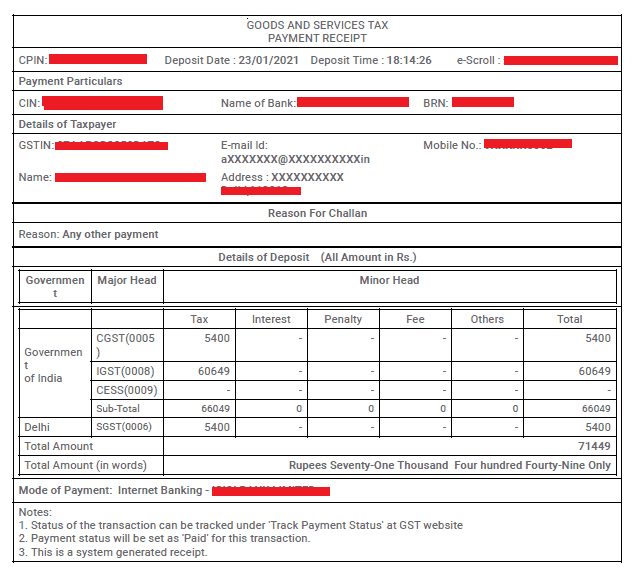
A taxpayer who wants to deposit tax, interest, penalty, fees or any other amount shall generate a challan in FORM GST PMT-06 on the common portal and enter the details of the amount to be deposited by him.

This is not a new concept. This is the same old challan we have been using to pay tax while filing GSTR-3B. Only the FORM GST PMT-06 has come into more notice amid QRMP Scheme.

How to Access the GST PMT-06 Challan?

  • Go to Services Tab
  • Click on Payments
  • Click on Create Challan

What has changed in GST PMT-06 due to QRMP Scheme?

As such, there is no change in the particulars of the Challan Form. But yes, while generating the Challan Form we need to follow a specific process. The same is given below for reference:

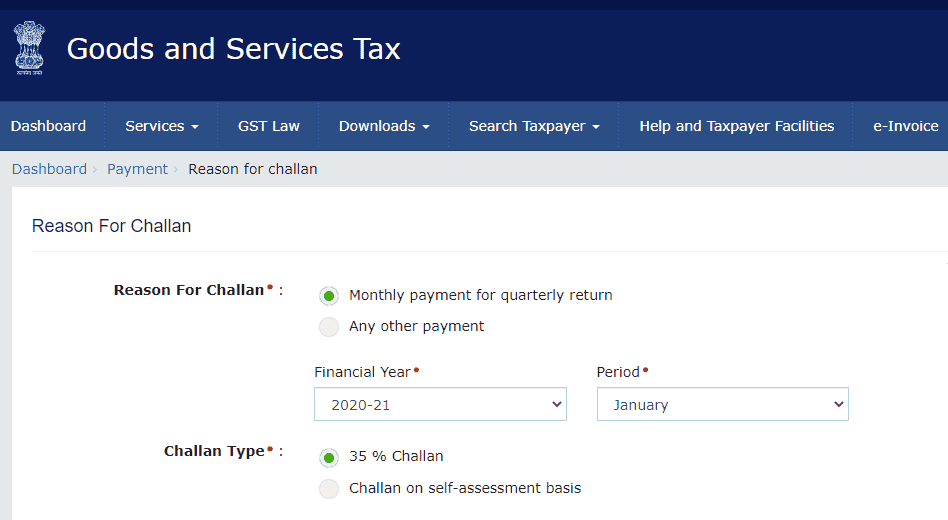
While generating the Challan Taxpayer needs to provide the Specific Reason for making the payment. The Reson can be:

  • Monthly Payment for Quarterly Return; In case you are making payment under QRMP Scheme
  • Any other payment

Monthly Payment for Quarterly Return will further be followed by:

  • 35% Challan
  • Challan on a self-assessment basis

Which reason should be selected by the Taxpayer while making payment through Challan GST PMT-06?

Option 1: Monthly Payment for Quarterly Return

This option will be selected by the taxpayer filing GSTR-3B on quarterly basis and intending to make payment for the first and second months of the quarter.

  • 35% Challan should be selected when you are making payment through Fixed Sum Method
  • Challan on a self-assessment basis should be selected if you are self-assessing your tax.

Please note that in the third month, the payment of Tax Liability will be Automatically routed to GST-PMT-06 Challan though Form-GSTR-3B. So Taxpayer is not required to select a specific option in 3rd Month. But if the taxpayer is generating challan manually in 3rd month, he has to choose Any other payment Option.

Option 2: Any other payment

A taxpayer who is not Filing returns under QRMP Scheme shall choose Any other payment option for making Tax Payment.

The following has been discussed in Brief:

Taxpayer Challan Option
M1 M2 M3
QRMP Opted Monthly Payment for Quarterly Return Monthly Payment for Quarterly Return Any other payment
QRMP Not Opted Any other payment Any other payment Any other payment

What are the Due Dates for making Payment of GST Output Liability?

Taxpayer M1 M2 M3
QRMP Opted 25th of next Month 25th of next Month 22nd/or 24th as per your Place of Bussiness
QRMP Not Opted 20th of next Month 20th of next Month 20th of next Month

How to Calculate Outstanding Tax Liability for Taxpayers under QRMP Scheme and otherwise?

Taxpayer M1 M2 M3
QRMP Opted 35% Payment Option If RP was a Quarterly Filler 35% of Tax paid in cash in Previous Quarter 35% of Tax paid in cash in Previous Quarter Actual Liability via GSTR-3B
If RP was a Monthly Filler 100% of Tax paid in cash in Previous month 100% of Tax paid in cash in Previous month Actual Liability via GSTR-3B
Self Assessment Self Assessed Tax Self Assessed Tax Actual Liability via GSTR-3B
QRMP Not Opted Actual Liability via GSTR-3B Actual Liability via GSTR-3B Actual Liability via GSTR-3B

The Tax liability will be reduced by the amount present in the Cash and credit ledger of the taxpayer.

Please note the below-mentioned Scenario for Better understanding:

Senarios Taxpayer Tax Liability to be discharged by GST PMT-09
M1 M2
1 Nil Liability 35% Payment Option NA NA
Self Assessment NA NA
2 Adequate Cash/ Credit Balance 35% Payment Option NA NA
Self Assessment NA NA
3 Adequate Cash/ Credit Balance in M1 but not in M2 35% Payment Option NA Auto-Generated Challan
Self Assessment NA Self Assessed Amount
4 Inadequate Cash/ Credit Balance 35% Payment Option Auto-Generated Challan Auto-Generated Challan
Self Assessment Self Assessed Amount Self Assessed Amount

Please note that in the 3rd Scenario, the Taxpayer can choose a payment option in M2 as in M1 he was not required to make any tax payment, thus the question of choosing a payment option did not arise.

What is the Late Fees Applicable on delayed Filing of Form GST PMT-06?

No Late Fees is applicable on delayed Filing of Form GST PMT-06.

What is the interest Applicable on delayed payment/short payment of taxes via Form GST PMT-06?

  • Delayed Filing of Form GST PMT-06

It means delayed payment of Taxes. Yes, interest is applicable u/s 50 on delayed Filing of Form GST PMT-06. The Rate of Interest is 18% pa.

For Example, interest is applicable when Tax is paid after the due date of 25th in case you have opted for QRMP Scheme.

  • Interest Short Payment of Taxes

35% Payment Option or Fixed Sum Method

No Interest is applicable if the taxpayer makes payment as per pre-filled challan and discharges remaining tax liability on due date of filing GSTR-3B.

Self Assessment Method

Interest is applicable if the taxpayer makes payment as per the self-assessment method and discharges the remaining tax liability after the due date.

Discussion Point:

Some clarification is still pending that what will happen is the taxpayer chooses wrong payment Option for making Tax.


from Studycafe https://ift.tt/2MlaR9V

CBIC issues new advisory on GSTR-9 Annual Return Form

CBIC issues new advisory on GSTR-9 Annual Return Form

Amid due date of GSTR-9 (GST Annual Return) and GSTR-9C (GST Audit) coming near, CBIC has issued a new advisory onGSTR-9 Annual Return Form.

The Advisory on GST Portal is as follows:

The taxpayers are advised to ensure that values are reported upto two decimal places in the GSTR-9 offline utility. The error “Error! Invalid Summary payload” after uploading the JSON created from the Offline Utility of GSTR-9 is reported due to reporting values upto three decimal places instead of two decimals.

Stakeholders should note that the due date for filing GSTR-9 (GST Annual Return) and GSTR-9C (GST Audit) for Financial Year 2019-20 is 28th February 2021.

Filing GST Audit (GSTR-9C) is compulsory for Aggregate Turnover of more than Rs. 5 Crore and GST Annual Return (GSTR-9) is compulsory for Aggregate Turnover of more than Rs. 2 Crore


from Studycafe https://ift.tt/3kmg6mA